September 11, 2026 — March 6, 2027
The Distance Inside Us (Bird and Lava)
Torkwase Dyson
Rectangle, Square, and Triangle galleries
Curated by Lillian O’Brien Davis
A rebellious abstraction
An unlikely geological mirroring occurs between the tar sands of Alberta and Pitch Lake of Trinidad and Tobago, both sites where the thick tar of bitumen is extracted. The history of colonial extraction in the Caribbean is well known, with sugar, rum, molasses, and coffee as the most prominent exports produced by the enslaved labour force brought to the region by the British, French, and Spanish. In most cases, Indigenous populations on the islands were almost totally wiped out through colonial violence and disease. While slavery was technically abolished in the British Empire in 1833, extractive and oppressive practices continue by other means. Thomas Cochrane, tenth Earl of Dundonald in Scotland, founded the Lake Asphalt of Trinidad and Tobago company in 1851, which continues to operate today. The UK-based company’s profits do not circulate back in a meaningful way to the country of Trinidad, whose environment is increasingly impacted by the process of extracting bitumen from the lake. Similarly in Canada, bitumen and oil extraction occurs throughout the province of Alberta, all of which is treaty land. While treaties initially were signed between the British Crown and Indigenous nations as agreements to share the land, resource extraction continues mostly by American and Canadian companies with benefits disproportionally flowing to settlers and corporations while local Indigenous nations feel the environmental cost of extraction on their lands and in their bodies, through polluted waters and the intensification of forest fire seasons. In both Canada and the Caribbean, the current activity of industrial extraction is made possible by earlier land dispossession of Indigenous peoples by settler forces.
Throughout the development of this exhibition, Torkwase Dyson has worked with a research assistant, Sarah Edo, to investigate the histories of extraction prominent on the northern side of the Medicine Line. Bitumen along with extraction of other forms of fossil fuels are one of the key reasons for Indigenous ongoing land dispossession and colonial extractive violence in North America. Dyson’s exhibition The Distance Inside Us (Bird and Lava) at The Goldfarb Gallery anchors itself in this context. Through her work, Dyson explores what it means to live inside these current ecological processes, participating in and living amidst the realities of late capitalism, or what Donna Haraway refers to as the Plantationocene. Dyson engages extraction as an ontological framework, drawing on the genre of abstraction as a structure for exercising the multitude of aporia that develops out of a close questioning of our experience of reality within this period of ecological crisis.
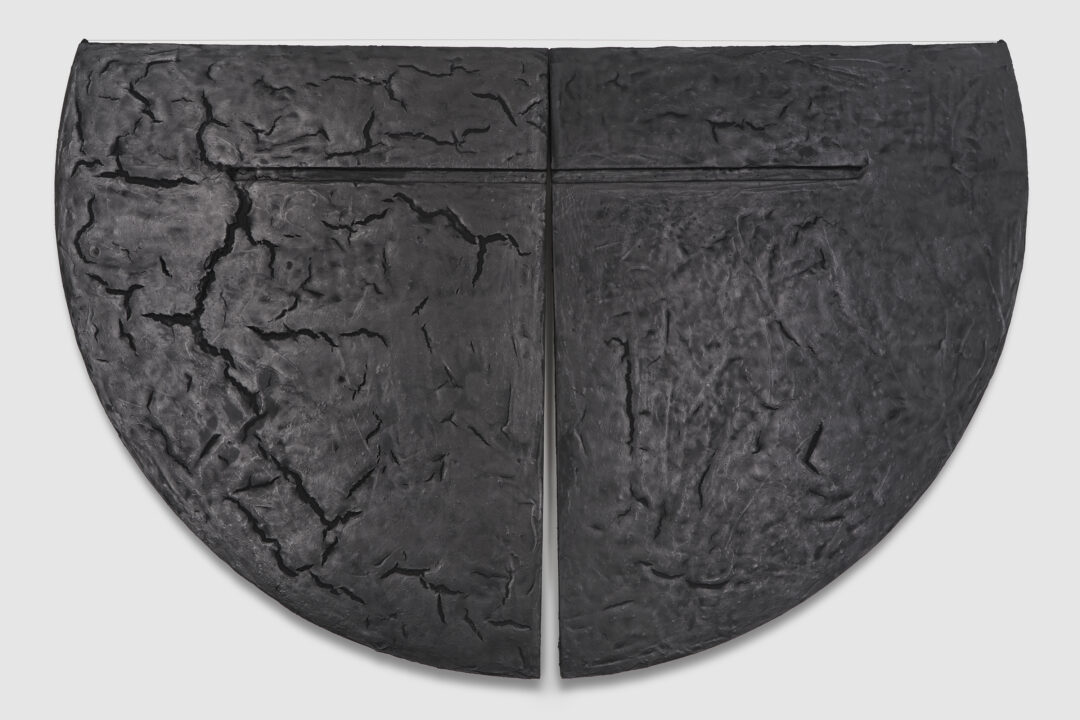
Presented together for the first time in the same space, Dyson’s Bird and Lava series consists of sculpture, painting, projected animations, and sound. The series explores the relationship between architectures of confinement and environmental liberation. Dyson uses an invented compositional system of curvilinear and rectilinear shapes to visually explore an infrastructure of resistance within geometric abstraction. The colour palette is intentionally spare, using dark tones to emphasize drawing and structural compositions that speak to the dexterity of self-liberators in developing trajectories and pathways through land and water toward freedom.
Recently I have been reading about Hale Woodruff’s painting Forest Fire, 1939, in which the artist depicts abstracted purple, red, and yellow smoke and flames billowing into the sky above a burning forest. In 2026, as forest fires have become significant characteristics of the summer months in Canada due to global warming, I am struck by the efficacy of Woodruff’s painting in capturing the scale and power of the flames. While the cause of the fire in Woodruff’s painting is not known, the depiction closely matches contemporary images of impossible-to-manage forest fires in Canada taken on by under-resourced firefighting crews who battle huge walls of flame; meanwhile, smoke billows across the Atlantic Ocean, impacting air quality as far away as Europe. Perhaps, cynically, we can understand this decrease in Europe’s air quality as a tangible consequence of Europe’s role in the birth and maintenance of capitalism, slavery, and industrial extraction. The invisible brutalities of colonialism not previously experienced in Europe beyond a full sugar dish and gilt walls have transformed into choking air and overcast skies.
Woodruff’s Forest Fire was included in the now-infamous exhibition Invisible Americans: Black Art of the 30s at the Studio Museum in Harlem in 1968—a corrective exhibition curated in response to an earlier programme that featured no artists of colour despite the significant Black artistic movement developing in New York in the 1930s known as the Harlem Renaissance. For contemporary critics and curators, Woodruff’s Forest Fire was obtuse, outside of his typical style of painting, outside of the subject matter a Black artist should paint, outside of “good” art. Writer Susan E. Cahan supposes that Woodruff, along with other African American artists active in New York in the 1930s, were omitted from major survey exhibitions of the period due to the dual assumptions: first, that African American artists only worked in Social Realist genre, and, second, that abstraction was the key medium of lasting importance during this period (Cahan, 129).
Dyson’s body of work takes as its inspiration the premise that abstraction is a rebellious mode, a tool by which we might envision alternative and liberatory architectures for Black and brown people. The work featured in this exhibition embraces abstraction as a means of tuning into frequencies of escape. For Dyson, abstraction dis-inherits forms of oppressive architectures, such as the slave hold, the prison or, more urgent now, the back of an ICE detention vehicle. Woodruff’s Forest Fire, an experiment in abstraction by an artist best known for more formal landscapes, is part of the lineage Dyson is operating within. Woodruff captures the violence and precarity of a forest consumed by flames, embracing what Dyson refers to in her own work as Black Compositional Thought, or black comp. Woodruff signals that this form of rebellious abstraction, a rebellion of thought, has always already been here.
York University has a long relationship with modernist abstraction, much of the foundation of the University’s permanent collection being made up of the Greenbergian generation of American, European, (and a few Canadian) White, male painters working in an abstracted mode, playing with form, colour, and shape to create an affect. For the University, modernist abstraction signalled its contemporary outlook as a comparatively “young” university, founded in the late 1950s. Many art historians have argued that meaning is secondary in these artworks; instead, the works are formalist exercises unbound to the identities or political ideologies of their makers. Scholars working to contradict this art historical positioning, however, contend that the celebration of abstraction as the highest calling for artists is not free of ideology, and itself is a rather distorted—and limited—ideological interpretation of an artist’s work (Cahan).
Claims of neutrality or “emptiness” are always worth troubling. What is now Canada was once considered an “empty” land waiting to be developed. This colonial concept was narrated to the wider world by colonial British and French monarchies but was also perpetuated by artists such as Lawren Harris and Tom Thomson of the Group of Seven whose rich but empty landscapes made the incorrect suggestion that the land they documented required their animation to imbue it with significance. Regarding Thomson’s mysterious death, a presumed murder in 1917, I often think of a friend’s glib comment: “well, there must have been at least one other person out there.” In this “empty” landscape, buffalo were hunted to extinction and Indigenous families were ripped apart, their people driven from their lands to make way for White settlers and extractive industries (across time: pelts, wood, oil, diamonds, and ore). As artist Tia-Simone Gardner offers in an unpublished essay, “the [location of a] pipeline is a claim about value, about whose land, whose water, whose body counts as resource and whose is obstructive.”
Art historian Darby English offers the proposition that art, particularly abstraction, can function as a “contact zone” for ideas, identities, and experiences (Cahan). For Dyson, that contact zone holds what she refers to as “bird and lava”: opposing experiences of confinement and pain, liberation and joy. The language of a zone of contact holds space for potential but also for pain, as historically what has come from first contact between African and North American Indigenous people with Europeans has been generations of extractive violence and dispossession of human bodies as well as resources and land. In reckoning with the dynamic and uneven transformations in our environment, what are the ideologies or values unspoken or unacknowledged that arise when we revisit the historical context of a medium like abstraction? Art Historian Jaleh Mansoor offers a framework for what surfaces:
What gets lost is that the modernists who write about aesthetic abstraction took politics to be the very framework of any emergent debate about art’s capacities, and its relevance. Taking as a given the Enlightenment imperative that aesthetics is a form of intellectual query both equal and other to science, as well as a dialectical critique of that very same Enlightenment, modernist aesthetics aspired to a kind of purposive purposelessness that functions all the more politically for being other to the rationalized and instrumental field of calculated rigidity (Mansoor, 54).
Dyson’s abstractions follow Mansoor’s line of thinking as it pushes against the understanding of abstraction as a genre of purposive purposelessness and engages with the political radicality (or revolution) that comes from a medium unbound by calculated rigidity, as Mansoor refers to it. Dyson’s rebellious abstractions are an expansive space that contain that which cannot be resolved. Through a spare and monochromatic use of colour and repeated forms —the square, referencing the box in which Henry “Box” Brown had himself shipped north; the triangle, referencing the garret in which Harriet Jacobs hid from her master; and the circle, the curve of the ship’s hull in which Anthony Burns stowed away—Dyson extracts, reduces, and refines these architectural forms of confinement into geometric shapes and painterly abstractions, what the artist refers to as hypershapes. With these hypershapes, Dyson opens up her theory of black comp as a mode of resistance to carceral and colonial architectures and infrastructures. Within the exhibition, the aesthetics of abstraction are in dialogue with the legacies of cacerality, enslavement, and extraction—complex and multi-layered histories are transformed into dense abstractions. The artist states: “the topography echoes familiar and enigmatic ecologies in my consciousness without the promise of stability. Embracing this indeterminacy, I think through how the transhistorical ethos of infrastructure space, both visible and invisible, resonates in liberation and world-building” (Gray Gallery).
The Bird and Lava series was born during the pandemic as the artist worked in isolation, using drawing as a monastic, meditative practice. The shape-language which runs throughout the series is a directive by the artist which literally illustrates the political potential of shape and surface to build new worlds.
Dyson draws on the work of renowned author Toni Morrison’s novel Beloved, 1987, for her series of Clearing paintings included in the exhibition. Within the density of colour and movement in her work, Dyson holds a long history of capture and flight through compositions which reimagine or re-form architectures of confinement—the artist draws us into the space of The Clearing as a framework for a new architectonic of freedom. In her novel, Morrison describes a gathering of recently liberated Black people in a forest clearing. Through the ministrations of the novel’s elder protagonist, Baby Suggs, the site of the clearing transforms into a liberatory architecture:
“Let the children come!” and they ran from the trees towards her.
“Let your mothers hear you laugh,” she told them, and the woods rang. The adults looked on and could not help smiling.
Then “Let the grown men come,” she shouted. They stepped out one by one from among the ringing trees.
“Let your wives and your children see you dance,” she told them, and groundlife shuddered under their feet.
Finally, she called the women to her. “Cry,” she told them. “For the living and the dead. Just cry.” And without covering their eyes the women let loose.
It started that way: laughing children, dancing men, crying women and then it got mixed up. Women stopped crying and danced; men sat down and cried; children danced, women laughed, children cried until, exhausted and riven, all and each lay about the Clearing damp and gasping for breath. In the silence that followed, Baby Suggs, holy, offered up to them her great big heart (Morrison, 113).
The transhistorical architecture of the Clearing represents a space born of Black liberation strategies formed to refuse slavery’s spatial violence. Dyson applies this spatial logic and its structural continuities to think through spatial strategies to resist the present ecological crisis. This period within the epoch of the Plantationocene is at a point where I am finally convinced that the pillars of modernism are falling down around us. For Dyson, the extractive condition is the constitutive material of her work—violence and land dispossession collide with freedom and hope. Dyson’s rebellious abstractions are an ongoing practice of holding space for what cannot be resolved. The Bird and Lava series was born out of this text. Dyson says:
In this moment of environmental precarity we will need to be both liquid and mountains, bird and lava. And it is the density of Black grace that will always be the thing that keeps us in our own humanity. Thinking through the histories of Black liberation, these are the victories that fortify my being in the objects I make. It’s time for a new relationship with abstraction, an illegal abstraction developed out of the condition of new world building toward liberation and revolution (Pace Gallery).
Through her compositional strategies, Dyson acts as a world-builder and cartographer, mapping new architectures of liberation through her work. As I sit down to write this essay I am located in Regina, Saskatchewan, Canada, a city with a huge oil refinery complex nestled in its north end. On night drives, you can see the flare of flames coming from the top of the gas stack, a huge beacon to the industry of extraction lighting up the north end of the city’s skyline. Recently, there has been activism to stop the construction of an AI data centre near the city. With a total provincial population of 1.2 million, the precarity that comes along with living in a place that many consider to be peripheral or “empty,” a place where a pipeline—or in this case, a data centre—will likely move ahead despite strong resistance from local settler and Indigenous communities. In this moment I look to Dyson’s rebellious abstractions because just as Baby Suggs calls her worshippers in to dance, to laugh, and to cry, Dyson invites us into the space of the clearing to fortify ourselves for what comes next.
– Lillian O’Brien Davis
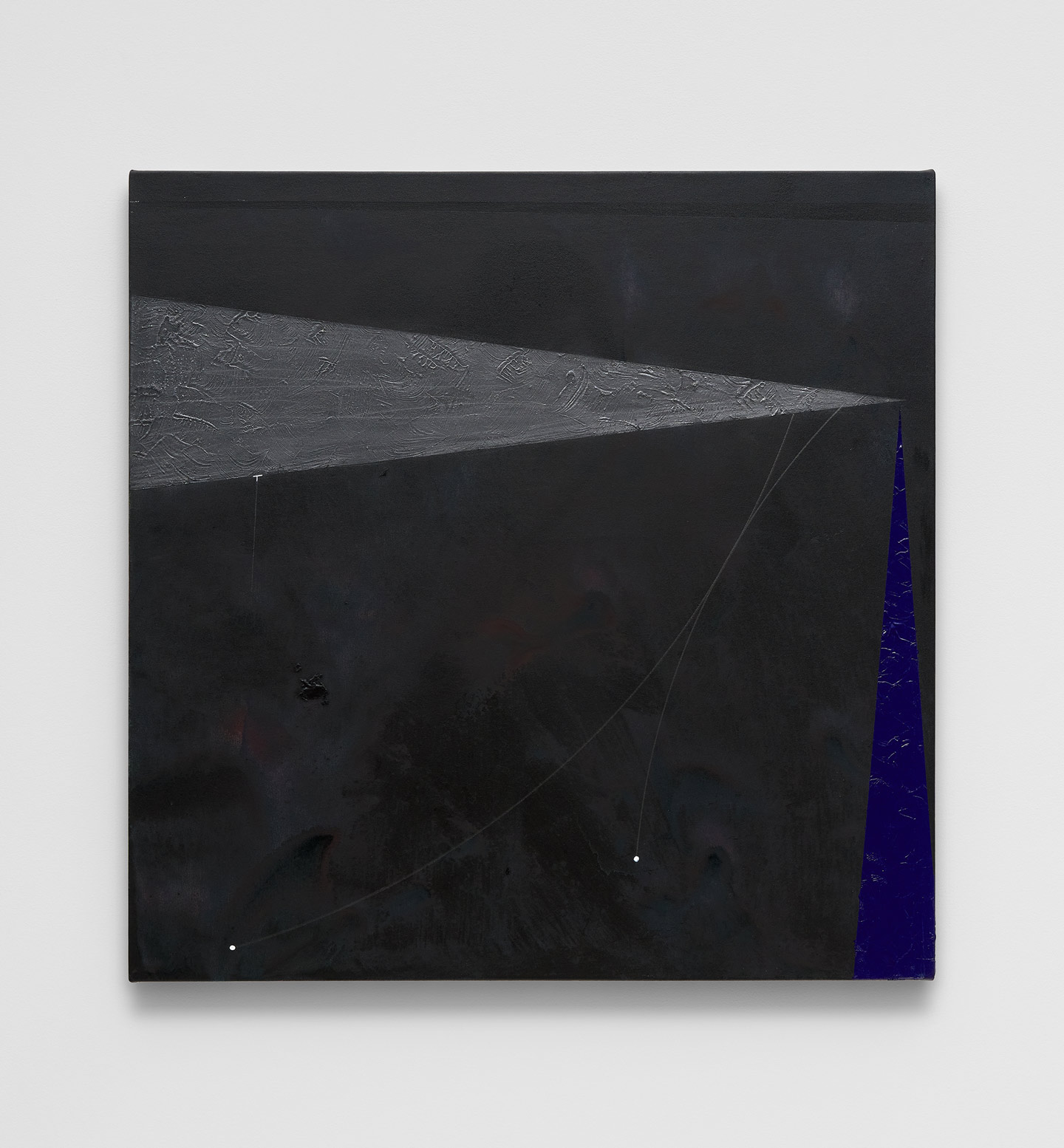
Torkwase Dyson, Departure (Bird and Lava), 2024.
Photograph: Lee Thompson, Flying Studio LA, courtesy Pace Gallery.
Works cited:
Cahan, Susan E. 2016. Mounting Frustration: The Art Museum in the Age of Black Power. Duke University Press.
Gardner, Tia-Simone. 2026 “Tetonic Intimacies | Rhizomatic Discourses” (manuscript).
Gray Gallery. 2025. “Of Line and Memory.” https://www.richardgraygallery.com/viewing-rooms/torkwase-dyson2.
Mansoor, Jaleh. 2025. Universal Prostitution and Modernist Abstraction: A Counterhistory. Duke University Press.
Morrison, Toni. 1987. Beloved. Alfred A. Knopf.
Pace Gallery. 2020. “Torkwase Dyson: Studies for Bird and Lava.” https://www.pacegallery.com/exhibitions/torkwase-dyson-studies-for-bird-and-lava.